The End of Freemium
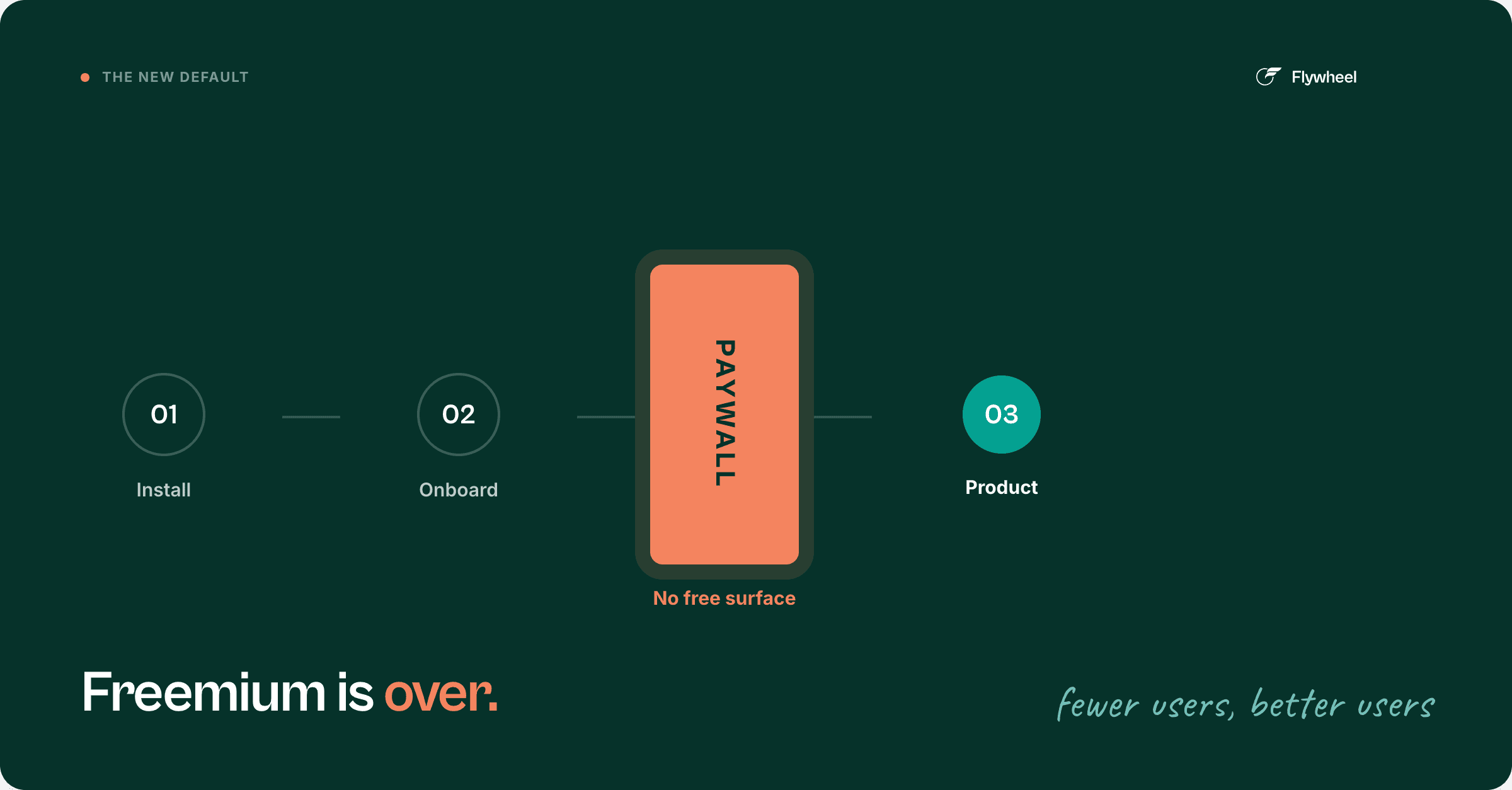
We've stopped recommending freemium for new apps and benchmark numbers are backing it up.
For years we ran the PLG playbook, which is popular in SaaS products. We used it for consumer mobile as well. Launch free, let people feel the value, convert once they're hooked. The biggest apps in the App Store were freemium apps, and copying the winners seemed like the right choice. It's a pitch we've been repeating for ~6 years now.
But that App Store, the one we were copying, doesn't exist anymore. Those winners were mass market products, and freemium math works when the funnel is a hundred million people wide. Today's apps are more niche - built for a specific person with a specific problem. When the product narrows, monetization, and GTM have to change with it.
Now we have data backing this decision up. RevenueCat's latest State of Subscription Apps report covers more than 115,000 apps and over $16 billion in subscription revenue. Apps with a hard paywall (where you hit the paywall during onboarding, before you can use anything) convert about 10.7% of downloads to paid by day 35. Freemium apps convert 2.1%. Revenue per install at day 60 runs roughly 8x higher, $3.09 against $0.38.
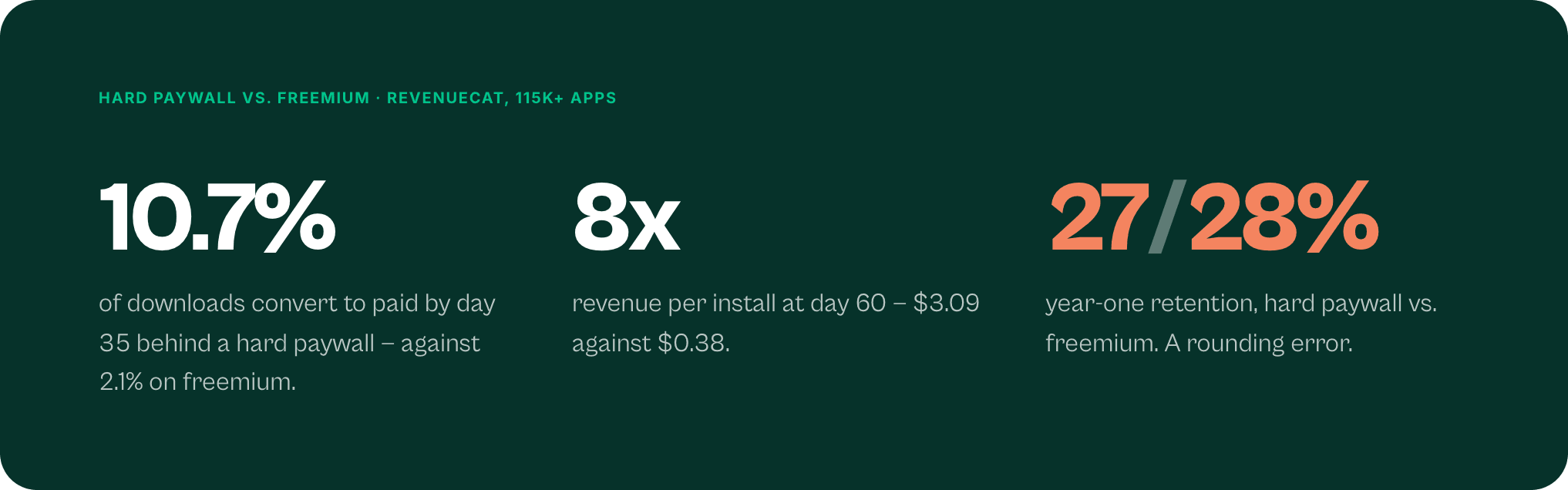
Previously, there was an argument about retention. The home screen is a sacred place - don't lose the user immediately. Show them value and let them convert later. Now, the numbers tell us that doesn't actually move the needle. Year one retention comes in at 27% for hard paywalls and 28% for freemium. A rounding error.
I want to disclose something - freemium is good for our business. Turning a free tier into paying customers is an optimization grind over years - upgrade prompts, feature gates, notification sequences, months of experiments - and optimization is billable work. A hard paywall is a week of design, and then it either converts or it doesn't. So in short, this actually decreases our short term billables.
Freemium Is Two Products
Here's the thing freemium quietly assumes. It assumes your app is so good that a stranger will keep using it for weeks, keep finding value, and eventually decide the paid version is worth it. That's not one product. It's two. You need a free experience good enough that people stay, and a paid experience so clearly better that they upgrade, without the free tier feeling crippled or fake.
Drawing that line takes months of tuning. Which feature do you gate? When does the upgrade prompt fire? Spotify has a decade of experiments behind every one of those answers. A new app doesn't.
The math makes this clearer. If 2% of your users ever pay, the other 98% are pure cost. You're running servers, support, and a roadmap for people who will never send you a dollar, at exactly the stage when you have the least margin to spare. A hard paywall inverts that: cash shows up on day one and goes straight back into the product. For a small team without funding, that cashflow isn't a nice-to-have. It's the runway.
Lastly, freemium inherently has some short term revenue loss. There are users on your app who aren't paying that would've on a hard paywall. New apps can't afford this loss.
Some Objections
Most founders push back, and it's a fair push. Won't a paywall kill our downloads? Don't we need users before we need revenue? Yes, you'll lose most of them. Put a price at the end of onboarding and most people bounce. The first time you watch that number, it stings.
But it's the wrong number to stare at. The people who bounce off a paywall aren't customers you lost. They're probably not customers at all. They're costs you avoided. The question was never how many people you can get into the app. It's how many will pay for the change the app promises.
There's a smarter version of the objection, and I hear it most from technical founders. More users means more feedback. Build a great product, the thinking goes, and conversion takes care of itself. Ship free, learn fast, monetize once the product has earned it.
I used to make this argument. The catch is that free users give you the wrong feedback. A paying user has skin in the game. When they complain, they're pointing at a job they're paying you to get done. A free user is reacting to a toy.
And free users don't just teach you less. They cost you more. They file the most tickets, make the most noise, and put nothing back into the platform. Follow that feedback and you end up steering the roadmap by the loudest slice of the 98% who will never pay.
The quieter cost is the revenue itself. Every month spent waiting for free users to come around is a month of revenue you chose not to collect. And revenue is feedback too, the only kind that can't lie. Pulling it forward isn't greed. It's how you fund the next iteration.
The Paywall Is the Commitment
There's a reframe underneath all of this. A paywall at the end of a strong onboarding isn't really a barrier. Someone downloads a fitness app because they want to become a person who works out. The onboarding shows them that life, the price appears, and paying becomes the first act of the commitment. The paywall isn't where you charge for the product. It's where the user commits to the outcome.
That's why hard paywalls perform best in health, fitness, and mindfulness, categories where the product is a promise about who you'll become. It's also why the exceptions are structural, not stylistic. If your app gets better with more people in it, don't charge at the door. A marketplace needs both sides in the room before it's worth anything to either, and the same goes for social apps and anything with real network effects. If the value comes from other users, charge later. If it comes from the product itself, charge now.
The New Default
So here's where we've landed as a studio. For new consumer apps, our default is now a hard paywall and sometimes a trial at the end of onboarding. Across the industry, more than 80% of trial starts happen on day zero, and the median trial conversion rate once someone starts is 38%. That means the onboarding funnel gets the design budget - it has to earn the price, screen by screen, before it ever shows one. Freemium moves to the end of the roadmap, something a product graduates into once it has revenue and data worth optimizing with.
We'll get some of these calls wrong, and some products will genuinely need a free tier sooner. But the default has flipped.
Which brings me back to the title. Freemium isn't ending for everyone. Spotify will be fine, and so will every mature app with the data to make a free tier pay. It's ending as the default monetization strategy for a brand-new app, the safe-feeling choice that was never actually safe. It was the expensive option dressed up as the generous one.
Free was never the cheap plan.