AI in the Loop: Redefining How We Build and Test
AI in the Loop: Redefining How We Build and Test

AI in the Loop: Redefining How We Build and Test

By

Bruno Matias Balderrabano

Published on:

Dec 4, 2025

AI in the Loop: Redefining How We Build and Test

At Flywheel, we immerse ourselves in the process of building apps. We have many talented people in leadership, PM, QA, and development, and everyone is in on the conversation of how we face the new year. We operate as a well-oiled machine that builds and brings to life amazing products, while constantly enhancing our internal processes to meet the growing and emergent technology that is AI.

We don’t live in the future; we live in an ever-changing world—a perpetual present driven by the talented work of the most brilliant minds living at the moment.

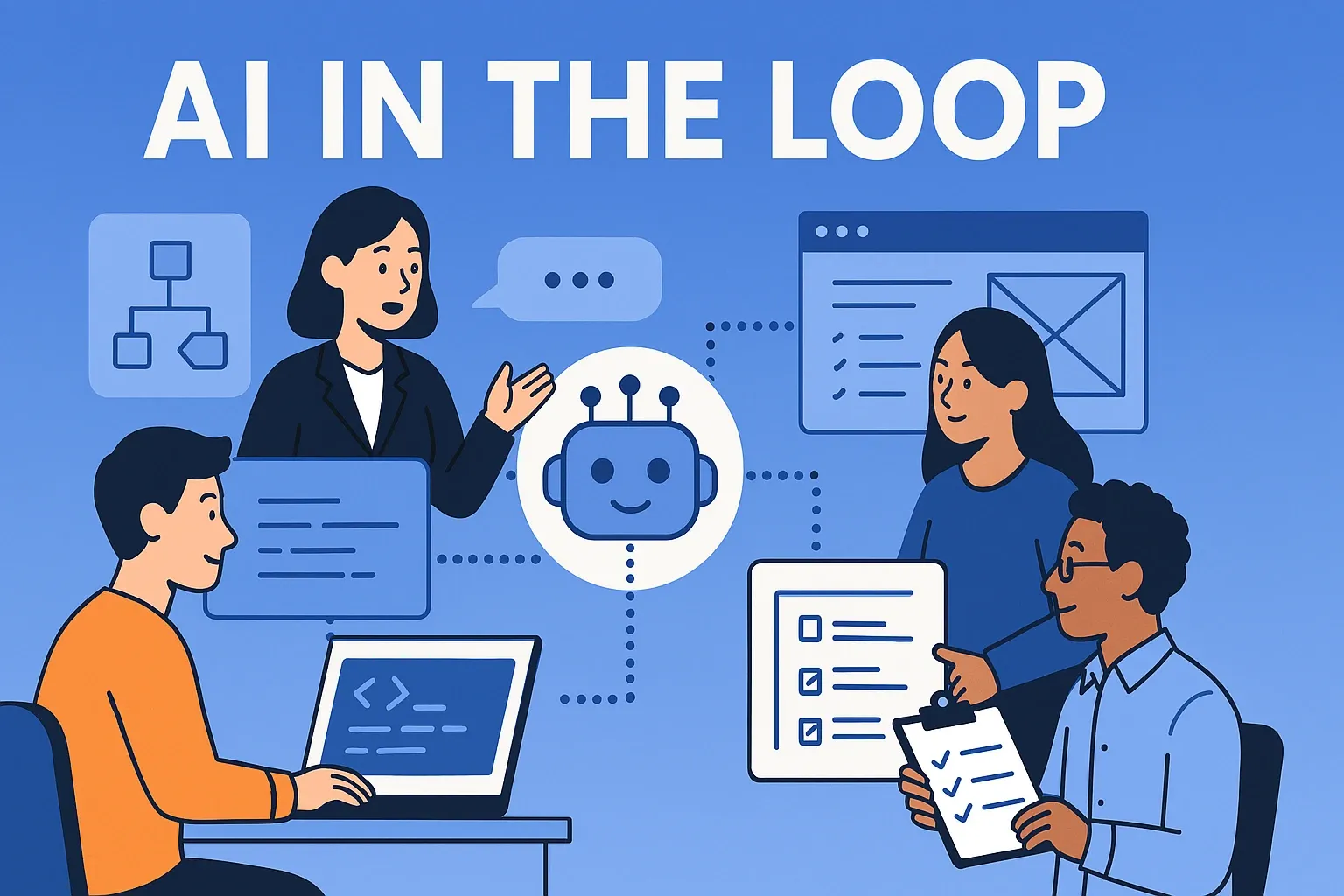
Through the internal adoption of these technologies in an increasingly growing portion of our day-to-day operations, we’ve come to realize that the way we build, develop, and design is evolving. AI is not just a tool on the side—it’s in the loop, embedded in how we design, build, and refine.

As a developer myself, it's not just about building fast anymore and iterating; it’s about building often and with purpose.

QA in the Loop

In traditional development, QA often comes late—after features are built, and when changes are costly and time-consuming. To maintain both momentum and quality, we started implementing testing very early and in context.

QA is now part of the flow of development and design, aiding us to catch and address issues early while we work on features, rather than after we have moved onto something else. This requires coordination, clear communication, and involved project management. It also requires a lot of fiddling with the functionalities of our applications—resetting accounts, dealing with time-restrictive features, or modifying specific states.

Imagine resetting a complex user flow with a single command, or simulating time-sensitive logic—like expiring promotions or session timeouts—without manually tweaking the backend. These aren’t hypotheticals.

We’re building agents that can manipulate application state, simulate edge cases, and even replicate real-world user behavior across multiple sessions. This allows us to validate assumptions while the code is still fresh, and long before it reaches a staging environment.

Tool Creation and Workflow Architecture

This is where speed matters, and where AI has the ability to truly revolutionize the industry. It acts as a tool for tool creation and workflow architecture.

Every atomic process that can be automated will eventually have a tailor-made feature implemented either in a vacuum or as part of a bigger ongoing application. These tools work alongside the main app development, ensuring everyone can contribute to the project in their best capacity.

The Somara Case Study: Speed vs. Structure

This approach came into sharp focus during the development of Somara, our internal collaboration platform.

In the early stages, we used AI to prototype and explore the product’s potential at a remarkable pace. But as the platform grew, we encountered the limitations of AI working alone. The code was functional, but fragile.

It was then that we realized: AI can help you build, but it can’t replace the disciplined eye of an experienced engineer.

We didn’t abandon AI, though. We brought it deeper into the loop. Now, we’re building specialized AI assistants that act like embedded team members. They help us enforce best practices, flag potential security risks, and suggest architectural improvements—in real time.

They don’t replace our judgment; they augment it.

The Future of Development

It is still quite early, but we are excited about the prospects of the future.

At Flywheel, we’re building a new way of working: one where humans and machines collaborate seamlessly, where iteration is continuous and intelligent, and where every line of code is part of a larger, more cohesive loop designed to expedite and enhance our productivity.

The future of development is smarter, and we’re just getting started.

AI in the Loop: Redefining How We Build and Test

At Flywheel, we immerse ourselves in the process of building apps. We have many talented people in leadership, PM, QA, and development, and everyone is in on the conversation of how we face the new year. We operate as a well-oiled machine that builds and brings to life amazing products, while constantly enhancing our internal processes to meet the growing and emergent technology that is AI.

We don’t live in the future; we live in an ever-changing world—a perpetual present driven by the talented work of the most brilliant minds living at the moment.

Through the internal adoption of these technologies in an increasingly growing portion of our day-to-day operations, we’ve come to realize that the way we build, develop, and design is evolving. AI is not just a tool on the side—it’s in the loop, embedded in how we design, build, and refine.

As a developer myself, it's not just about building fast anymore and iterating; it’s about building often and with purpose.

QA in the Loop

In traditional development, QA often comes late—after features are built, and when changes are costly and time-consuming. To maintain both momentum and quality, we started implementing testing very early and in context.

QA is now part of the flow of development and design, aiding us to catch and address issues early while we work on features, rather than after we have moved onto something else. This requires coordination, clear communication, and involved project management. It also requires a lot of fiddling with the functionalities of our applications—resetting accounts, dealing with time-restrictive features, or modifying specific states.

Imagine resetting a complex user flow with a single command, or simulating time-sensitive logic—like expiring promotions or session timeouts—without manually tweaking the backend. These aren’t hypotheticals.

We’re building agents that can manipulate application state, simulate edge cases, and even replicate real-world user behavior across multiple sessions. This allows us to validate assumptions while the code is still fresh, and long before it reaches a staging environment.

Tool Creation and Workflow Architecture

This is where speed matters, and where AI has the ability to truly revolutionize the industry. It acts as a tool for tool creation and workflow architecture.

Every atomic process that can be automated will eventually have a tailor-made feature implemented either in a vacuum or as part of a bigger ongoing application. These tools work alongside the main app development, ensuring everyone can contribute to the project in their best capacity.

The Somara Case Study: Speed vs. Structure

This approach came into sharp focus during the development of Somara, our internal collaboration platform.

In the early stages, we used AI to prototype and explore the product’s potential at a remarkable pace. But as the platform grew, we encountered the limitations of AI working alone. The code was functional, but fragile.

It was then that we realized: AI can help you build, but it can’t replace the disciplined eye of an experienced engineer.

We didn’t abandon AI, though. We brought it deeper into the loop. Now, we’re building specialized AI assistants that act like embedded team members. They help us enforce best practices, flag potential security risks, and suggest architectural improvements—in real time.

They don’t replace our judgment; they augment it.

The Future of Development

It is still quite early, but we are excited about the prospects of the future.

At Flywheel, we’re building a new way of working: one where humans and machines collaborate seamlessly, where iteration is continuous and intelligent, and where every line of code is part of a larger, more cohesive loop designed to expedite and enhance our productivity.

The future of development is smarter, and we’re just getting started.

Book an introductory call

We'd love to hear about what you're working on…

© 2025 Flywheel

Book an introductory call

We'd love to hear about what you're working on…

© 2025 Flywheel

Book an introductory call

We'd love to hear about what you're working on…

© 2025 Flywheel

Book an introductory call

We'd love to hear about what you're working on…

© 2025 Flywheel