

What Is Airtable Used For? And Why an App Development Studio Might Be the Better Solution
By
Rodrigo Martinez
Published on:
Airtable has become one of the most popular tools for startups looking to organize data, manage workflows, and move quickly without heavy engineering. Its flexibility and ease of use make it ideal for a wide range of Airtable use cases, from CRMs and content planning to internal tools and lightweight product backends. For many teams, especially in early stages, Airtable offers a powerful way to build systems fast without relying on developers.
Because of this, Airtable for startups has become a go-to solution in the world of no-code vs custom development. It allows founders to validate ideas, streamline operations, and launch MVPs without investing in full engineering teams. This speed and accessibility are key advantages, particularly when time to market is critical. However, as products grow, the conversation naturally shifts toward Airtable vs custom app development and whether no-code tools can support long-term scalability.
This is where many teams begin to encounter Airtable limitations. While the platform works well for internal workflows and early prototypes, it often struggles when used as the foundation for user-facing products or complex systems. As businesses scale, they require more flexibility, performance, and control — which is where a mobile app development agency offering custom app development services becomes essential. Moving toward scalable app development allows companies to build products that grow with their users instead of being constrained by the tools they started with.
What Is Airtable Used For?
At its core, Airtable is a no-code database platform that allows users to store, organize, and manipulate data in a highly visual way. Think of it as a spreadsheet, but with relational database capabilities and built-in automation features.
Companies use Airtable for a wide range of use cases. It’s commonly adopted for project management, content planning, CRM systems, inventory tracking, and internal tools. Teams can create custom workflows, link data across tables, and automate repetitive tasks without writing code.
For startups and small teams, Airtable is especially appealing because it allows them to move fast. Instead of waiting weeks or months for a development team, they can build internal systems in a matter of days.
This speed makes Airtable a powerful tool for early-stage experimentation.
Why Airtable Works So Well (At First)
One of Airtable’s biggest advantages is its simplicity. It lowers the barrier to entry for building tools and organizing information. Teams don’t need a technical background to get started, and the interface is intuitive enough for almost anyone to use.
It also integrates easily with other platforms, allowing businesses to connect Airtable with marketing tools, analytics platforms, and automation systems. This makes it a strong foundation for internal operations.
For many companies, Airtable becomes the “operating system” behind their workflows.
But this is where things start to get interesting.
Where Airtable Starts to Break
As businesses grow, their needs evolve. What starts as a simple internal tool often becomes a critical part of operations. And that’s when Airtable can begin to show its limitations.
Performance can become an issue as data grows. Complex workflows become harder to manage. User experiences are limited, especially if you want to build customer-facing products. Permissions, scalability, and customization can also become constraints.
Most importantly, Airtable is not designed to be a fully scalable product platform.
If you’re building something that users interact with daily — like a mobile app, marketplace, or SaaS product — Airtable alone is rarely enough.
Airtable vs Custom App Development
This is where the shift happens.
Airtable is excellent for internal tools and early-stage prototypes. But when your product becomes core to your business, you need more control, flexibility, and scalability.
Custom app development allows you to:
create fully tailored user experiences
integrate deeply with third-party services
scale performance as your user base grows
build mobile-first products
implement advanced features like AI, real-time data, and personalization
Instead of adapting your business to the tool, you build a product that adapts to your business.
Why an App Development Studio Is Often the Next Step
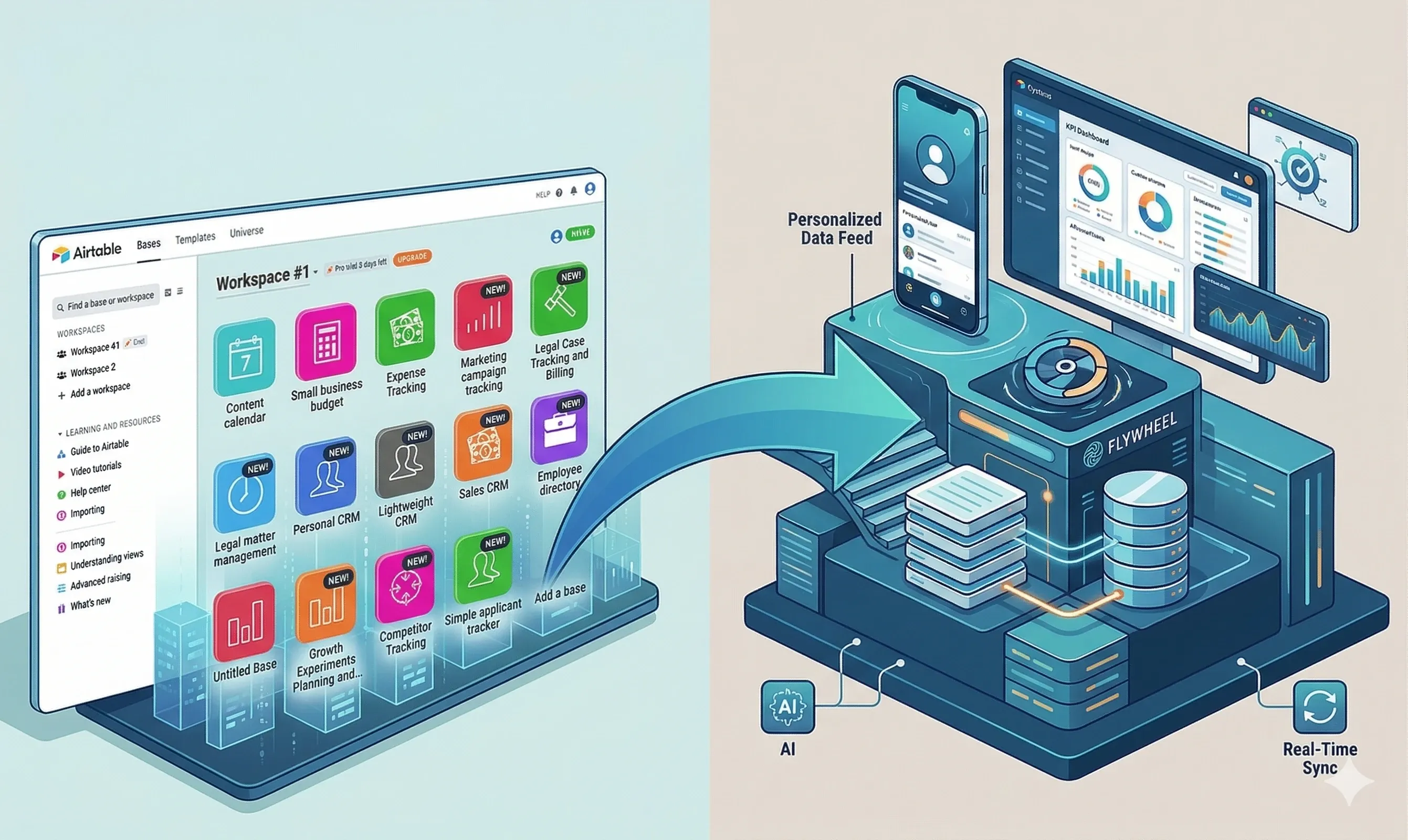
Working with an app development studio like Flywheel Studio bridges the gap between rapid experimentation and scalable product execution.
At Flywheel, we often see companies that started with Airtable. It helped them validate ideas, organize operations, and move quickly. But once they reached product-market fit, they needed something more robust.
That’s where we come in.
We help transform early systems into fully developed applications — whether that means building a mobile app, creating a marketplace, or developing a custom platform that supports growth.
The goal isn’t to replace Airtable immediately, but to evolve beyond it when the business is ready.
The Best Approach: Airtable + Custom Development
It’s not always about choosing one or the other.
In many cases, the best solution is a hybrid approach. Airtable can still be used as a backend tool for internal operations, while a custom application provides the front-end experience for users.
This allows businesses to maintain flexibility while delivering a high-quality product.
The key is knowing when to make that transition.
Airtable is an incredibly powerful tool for organizing data and building workflows quickly. It enables teams to move fast, test ideas, and operate efficiently without heavy technical investment.
But as your product grows, so do your requirements.
If your platform is becoming central to your business — if users depend on it daily — it may be time to move beyond no-code tools and invest in a scalable, custom-built solution.
At Flywheel Studio, we specialize in helping companies make that transition. From early-stage concepts to fully developed applications, we design and build products that are meant to grow.
Because building something quickly is valuable.
But building something that lasts — that’s what really matters.
Airtable has become one of the most popular tools for startups looking to organize data, manage workflows, and move quickly without heavy engineering. Its flexibility and ease of use make it ideal for a wide range of Airtable use cases, from CRMs and content planning to internal tools and lightweight product backends. For many teams, especially in early stages, Airtable offers a powerful way to build systems fast without relying on developers.
Because of this, Airtable for startups has become a go-to solution in the world of no-code vs custom development. It allows founders to validate ideas, streamline operations, and launch MVPs without investing in full engineering teams. This speed and accessibility are key advantages, particularly when time to market is critical. However, as products grow, the conversation naturally shifts toward Airtable vs custom app development and whether no-code tools can support long-term scalability.
This is where many teams begin to encounter Airtable limitations. While the platform works well for internal workflows and early prototypes, it often struggles when used as the foundation for user-facing products or complex systems. As businesses scale, they require more flexibility, performance, and control — which is where a mobile app development agency offering custom app development services becomes essential. Moving toward scalable app development allows companies to build products that grow with their users instead of being constrained by the tools they started with.
What Is Airtable Used For?
At its core, Airtable is a no-code database platform that allows users to store, organize, and manipulate data in a highly visual way. Think of it as a spreadsheet, but with relational database capabilities and built-in automation features.
Companies use Airtable for a wide range of use cases. It’s commonly adopted for project management, content planning, CRM systems, inventory tracking, and internal tools. Teams can create custom workflows, link data across tables, and automate repetitive tasks without writing code.
For startups and small teams, Airtable is especially appealing because it allows them to move fast. Instead of waiting weeks or months for a development team, they can build internal systems in a matter of days.
This speed makes Airtable a powerful tool for early-stage experimentation.
Why Airtable Works So Well (At First)
One of Airtable’s biggest advantages is its simplicity. It lowers the barrier to entry for building tools and organizing information. Teams don’t need a technical background to get started, and the interface is intuitive enough for almost anyone to use.
It also integrates easily with other platforms, allowing businesses to connect Airtable with marketing tools, analytics platforms, and automation systems. This makes it a strong foundation for internal operations.
For many companies, Airtable becomes the “operating system” behind their workflows.
But this is where things start to get interesting.
Where Airtable Starts to Break
As businesses grow, their needs evolve. What starts as a simple internal tool often becomes a critical part of operations. And that’s when Airtable can begin to show its limitations.
Performance can become an issue as data grows. Complex workflows become harder to manage. User experiences are limited, especially if you want to build customer-facing products. Permissions, scalability, and customization can also become constraints.
Most importantly, Airtable is not designed to be a fully scalable product platform.
If you’re building something that users interact with daily — like a mobile app, marketplace, or SaaS product — Airtable alone is rarely enough.
Airtable vs Custom App Development
This is where the shift happens.
Airtable is excellent for internal tools and early-stage prototypes. But when your product becomes core to your business, you need more control, flexibility, and scalability.
Custom app development allows you to:
create fully tailored user experiences
integrate deeply with third-party services
scale performance as your user base grows
build mobile-first products
implement advanced features like AI, real-time data, and personalization
Instead of adapting your business to the tool, you build a product that adapts to your business.
Why an App Development Studio Is Often the Next Step
Working with an app development studio like Flywheel Studio bridges the gap between rapid experimentation and scalable product execution.
At Flywheel, we often see companies that started with Airtable. It helped them validate ideas, organize operations, and move quickly. But once they reached product-market fit, they needed something more robust.
That’s where we come in.
We help transform early systems into fully developed applications — whether that means building a mobile app, creating a marketplace, or developing a custom platform that supports growth.
The goal isn’t to replace Airtable immediately, but to evolve beyond it when the business is ready.
The Best Approach: Airtable + Custom Development
It’s not always about choosing one or the other.
In many cases, the best solution is a hybrid approach. Airtable can still be used as a backend tool for internal operations, while a custom application provides the front-end experience for users.
This allows businesses to maintain flexibility while delivering a high-quality product.
The key is knowing when to make that transition.
Airtable is an incredibly powerful tool for organizing data and building workflows quickly. It enables teams to move fast, test ideas, and operate efficiently without heavy technical investment.
But as your product grows, so do your requirements.
If your platform is becoming central to your business — if users depend on it daily — it may be time to move beyond no-code tools and invest in a scalable, custom-built solution.
At Flywheel Studio, we specialize in helping companies make that transition. From early-stage concepts to fully developed applications, we design and build products that are meant to grow.
Because building something quickly is valuable.
But building something that lasts — that’s what really matters.

